- Devised the 2026 implementation plan comprised of eight strategies and fourteen key tasks -
Incheon Metropolitan City (Mayor Yoo Jeong-bok) is set to undergo a comprehensive overhaul of its emergency medical response system. The initiative focuses on safeguarding the lives and safety of citizens by seamlessly connecting the entire process—from emergency patient transport to hospital acceptance, treatment, and disaster response.
On March 26, the city announced that it had established the “2026 Emergency Medical Services Implementation Plan” and would begin operating a faster and more coordinated emergency response system. The plan was formulated under the Emergency Medical Service Act and the Incheon Metropolitan City Ordinance on Emergency Medical Service Support. The core objective is to enable emergency medical care without delay through an uninterrupted flow of each stage—from on-site transport to hospital treatment and disaster response.
The plan consists of eight strategies and 14 key tasks, including: improving transport and hospital acceptance systems for critically ill patients, and ensuring rapid transport systems; expanding support for vulnerable areas; enhancing treatment processes for severe emergency cases; reinforcing regional emergency medical governance; expanding CPR education to secure the golden hour; boosting disaster response capabilities through training; and establishing cooperative networks for infectious disease and disaster response.
In particular, the city will further strengthen collaboration not only among internal departments but also with local emergency medical institutions and related agencies such as fire and police authorities. The goal is to minimize potential gaps in the response process from the field to hospitals and to ensure immediate action in emergencies.
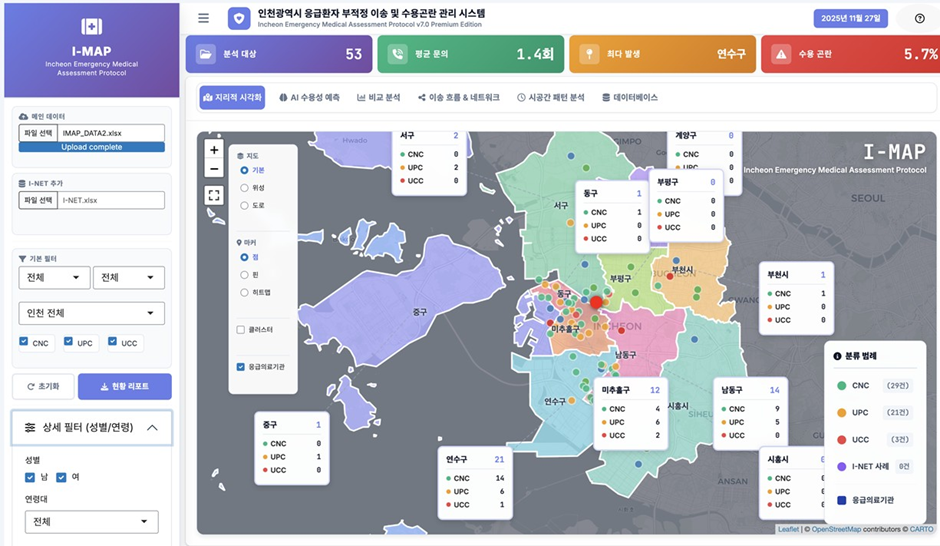
Upgrades will also be made to the “Incheon Emergency Assessment Protocol (I-MAP),” which is already in operation. Introduced in December 2025 as the first system of its kind nationwide, I-MAP classifies cases of delayed patient transport or difficulty in hospital acceptance and visualizes patient transfer flows.
The system supports more rational decision-making by categorizing suspected inappropriate cases into three levels: cases requiring adjustment, cases with potential for improvement, and cases involving difficulty in acceptance. The city plans to continuously refine transport and acceptance standards through ongoing consultation with related agencies based on this data.
Under this framework, Incheon is accelerating efforts to eliminate so-called “hospital runarounds” for emergency patients. These policies are taking root in the field, centered on securing the golden hour and minimizing transport delays. The city plans to further expand their impact in 2026 through a more advanced, precise response system.
Shin Byung-cheol, Director of the Incheon Health and Welfare Bureau, stated, “Emergency medical care ultimately comes down to time and connectivity. Through this implementation plan, we will focus on fostering an environment where anyone can receive timely treatment in urgent situations.” He added, “We will remain committed to strengthening an emergency medical safety net that citizens can rely on.”
 Automatic Translation
Initialize
Automatic Translation
Initialize
