- Tree-planting event held in Mongolia on May 21, highlighting the global model for fine dust reduction and climate diplomacy -
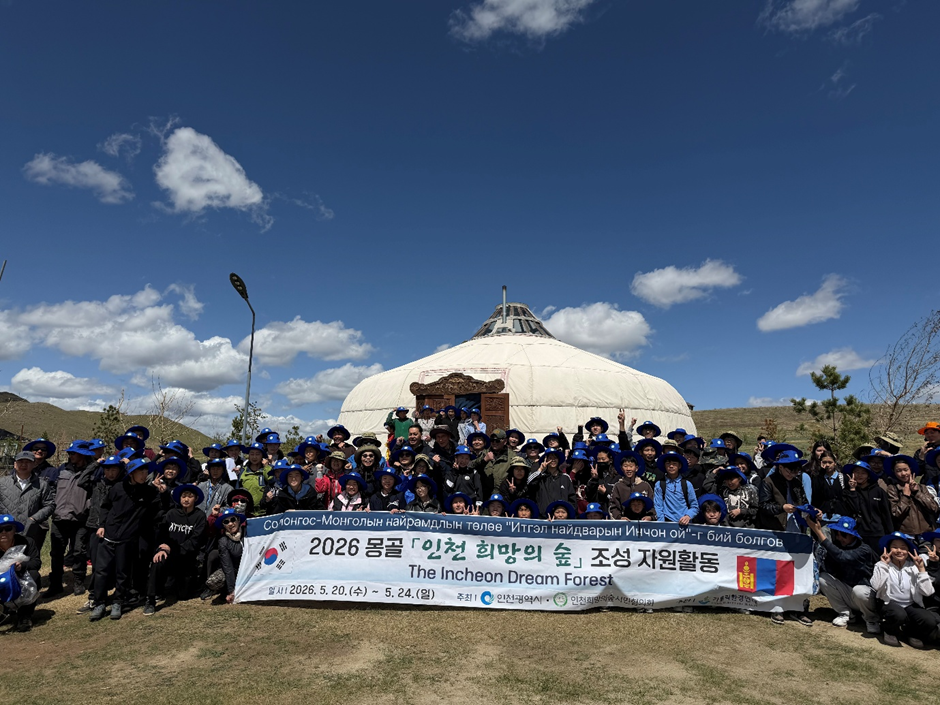
After 19 years of development by the Incheon Metropolitan City, the Incheon Hope Forest project is now delivering tangible results toward carbon neutrality and establishing itself as a key model for responding to the climate crisis in Northeast Asia.
The city held the “2026 Incheon Hope Forest” tree-planting event on May 21 at an afforestation site in Songino Khairkhan District, Ulaanbaatar, Mongolia. Approximately 100 participants—including 29 student and citizen volunteers from Incheon, officials from both countries, and local Mongolian students—gathered to plant around 1,000 pine trees.
The event was designed not only to bring new life to Mongolia—regarded as one of the major sources of fine dust affecting Korea—but also to serve as a meaningful educational opportunity to raise awareness among future generations regarding the seriousness of climate change. Participants delivered a message of environmental solidarity beyond national borders by conducting anti-desertification activities alongside the tree planting.
The Incheon Hope Forest project began in 2008 through the citizen-led “Planting Hope Trees to Prevent Yellow Dust” campaign. What started as a small-scale civic initiative gradually expanded with administrative and financial support from the city government, growing over the past 19 years into a massive green zone covering 157 hectares.
This area is larger than 220 soccer fields combined, accounting for approximately 54% of the total area of Seoul's Yeouido. The project laid the foundation for creating a vast “green barrier” in the barren Mongolian desert through the efforts of Incheon citizens, with a total of approximately 250,000 trees having taken root there to date.
The long-running afforestation project is now proving its value through measurable data. The city expects the Incheon Hope Forest project to reduce greenhouse gas emissions by approximately 1,620 tons of carbon dioxide equivalent (tCO2eq) this year alone. This quantity is tantamount to the full offsetting of the annual carbon emissions generated by approximately 350 internal combustion engine passenger vehicles. In particular, since the carbon absorption capacity of trees increases significantly as they mature, the reduction effect is seen to grow even further in the future.
Incheon plans to continue developing the project beyond simple tree planting into a core asset of global climate diplomacy that simultaneously addresses fine dust reduction at the source, greenhouse gas mitigation, and strengthening of the Korea-Mongolia friendship.
According to Yoon Eun-joo, Head of the Incheon Environmental Safety Division, the Incheon Hope Forest is a shared asset for humanity created through the combination of citizens’ passion and the city’s policies. “Based on close partnerships with the Mongolian government, we will continue advancing the afforestation project so that Incheon can establish itself as a leading city in the era of global carbon neutrality,” she added.
 Automatic Translation
Initialize
Automatic Translation
Initialize
