Incheon is embarking on global innovation policy cooperation with major cities around the world, including those in Europe, to transition into a sustainable city of the future.
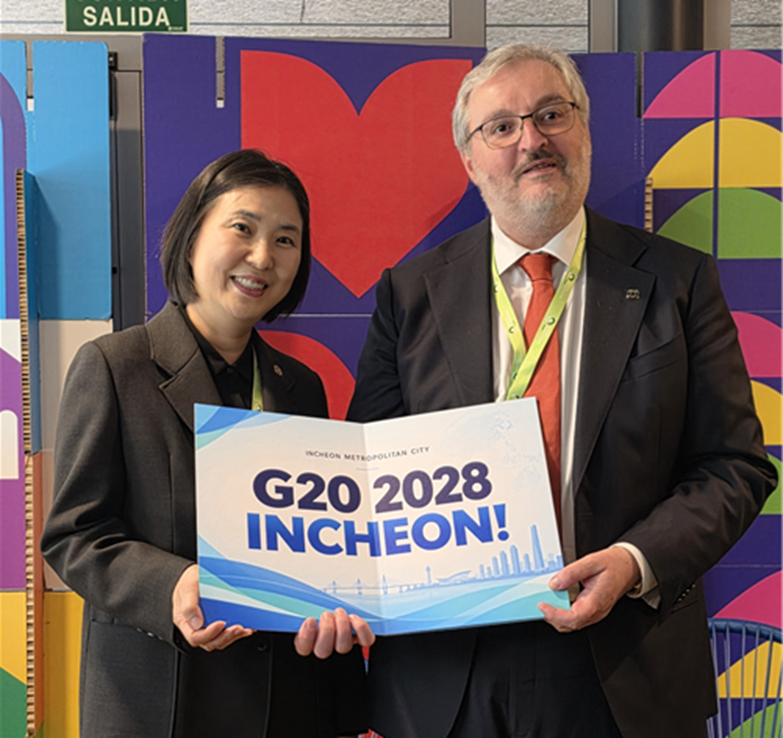
Incheon Metropolitan City announced on the 3rd that it attended the “2026 UTM Global Innovation Summit” held in Villadecans, Spain, and joined the Urban Transitions Mission (UTM) as the first city in South Korea and the 150th city worldwide to participate. New participating cities included Incheon, Lyon, France, and Porto, Portugal.
The Urban Transitions Mission (UTM) is an international urban cooperation network jointly led by the European Commission and the Global Covenant of Mayors for Climate & Energy (GCoM).
It shares policy experiences and achievements to enable cities worldwide to pursue carbon neutrality and sustainable urban transitions, and supports the practical application and dissemination of innovative policies and technologies in various fields—such as urban planning, transportation, and energy—on the ground.
Nam Young-hee, Deputy Mayor for Balanced Development, who attended the event as Incheon’s representative, met with network officials—including Philippe Froissard, Head of the Urban Transformation Unit at the European Commission’s Directorate-General for Research and Innovation—to discuss urban policy innovation and international cooperation strategies.
Additionally, during the summit’s welcome reception, she exchanged greetings with Anne Hidalgo, former Mayor of Paris, who spearheaded the establishment of the “15-minute city” concept, and built consensus on people-centered, sustainable urban policies.
During the subsequent international cooperation session, Incheon City presented a case study on urban planning innovation that combines “ComPlanAI”—an AI-based urban planning system—with a “citizen participation platform” that allows residents to directly report daily inconveniences or suggest improvements.
In particular, the city received a very positive response for proposing a quadrant model that combines spatial data on urban services with citizens’ perceived accessibility to classify living area conditions into four types, and utilizes this to formulate policies and determine investment priorities for balanced development across living areas.
The Deputy Mayor for Balanced Development stated, “Taking our participation in UTM as an opportunity, we will translate the shared goals of carbon neutrality and sustainability into policies that citizens can tangibly experience, such as urban planning, transportation, and improvements to the living environment,” adding, “We will proceed without delay to ensure that citizens can directly participate in policy-making and experience these changes in their daily lives.”
Incheon City plans to actively incorporate the results of this international joint research into the “2045 Incheon Master Plan” and the “Living Area Plans,” and to continue expanding global policy exchanges with other UTM participating cities.

