- Bill establishing Maritime Court passed in plenary session on the 12th, opening scheduled for March 2028 -
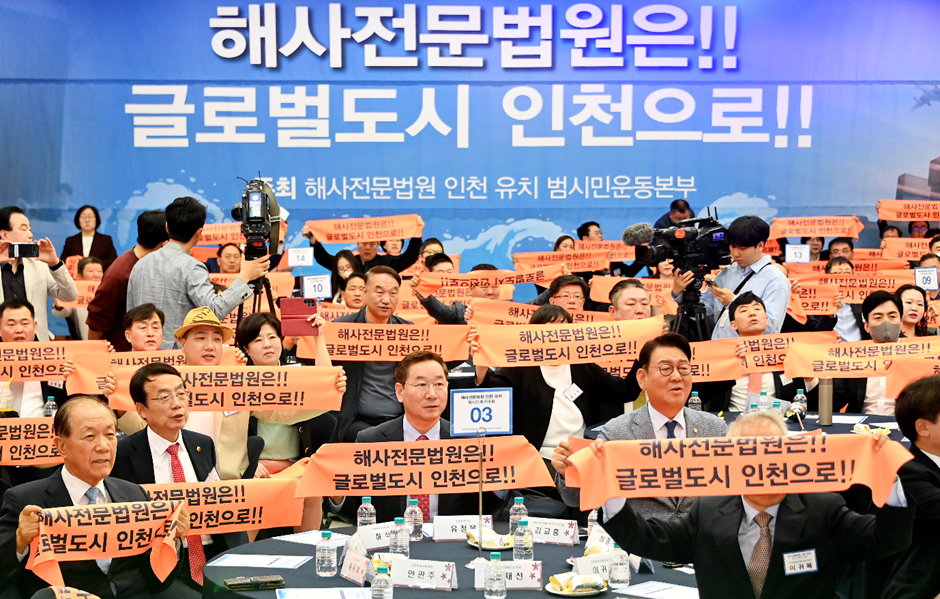
Incheon Metropolitan City (Mayor Yoo Jeong-bok) announced that the long-cherished wish of Incheon citizens for the ‘establishment of a maritime court’ has been finally confirmed, following the passage of bills related to the maritime court's establishment in the National Assembly plenary session on the 12th. These included amendments to the 「Court Organization Act」 and the 「Act on the Establishment and Jurisdictional Areas of Courts at Each Level」.
The officially designated name of the newly established court is the ‘Incheon Maritime and International Commercial Court’. It is a specialized court with comprehensive jurisdiction over maritime cases arising at sea as well as international commercial disputes. Only two such Maritime and International Commercial Courts will be established nationwide (Incheon and Busan), with the target opening date set for March 2028.
The Incheon Maritime International Commercial Court will have jurisdiction over the central region, including Seoul, Gyeonggi, Gangwon, and Chungcheong. It is expected to significantly improve judicial accessibility, as parties can agree to have cases originating anywhere in the country tried in Incheon.
Securing the ‘Incheon Maritime Court’ has been a fervent aspiration of Incheon citizens and a core issue for the city over the past decade. While bills stalled or lapsed due to term expirations in the 20th and 21st National Assemblies, the 22nd Assembly finally cleared the legislative hurdle through bipartisan cooperation and full support from the local political sphere.
Throughout this period, Incheon City has conducted multifaceted efforts alongside the ‘Incheon Citizens’ Movement Headquarters for Attracting the Maritime Court'. Notably, a large-scale signature campaign involving 1.11 million participants served as a symbolic achievement demonstrating citizens' strong will for the court's establishment. The city directly delivered the signature book to the National Assembly and the National Court Administration, hosted National Assembly debates, and organized citywide relay support declarations, continuously persuading stakeholders of the court's necessity and justification.
Once the Maritime and International Commercial Court is established, Incheon is expected to leverage its position as the capital region hub—home to 64.2% of domestic shipping companies and approximately 80% of international logistics firms—to provide swift and specialized judicial services for maritime and international commercial disputes involving neighboring countries like China.
Furthermore, it is expected to inject vitality into the Incheon regional economy by repatriating approximately 500 billion won in annual litigation costs that previously flowed overseas, while also generating economic ripple effects through visits by domestic and international litigants, leading to increased accommodation, tourism, and MICE industry activity.
Mayor Yoo Jeong-bok stated, “The long-cherished aspiration of Incheon's 3 million citizens and the core legal infrastructure for Incheon's leap toward becoming a global maritime city will finally be established in Incheon,” adding, “By adding international dispute resolution capabilities to Incheon, which already possesses a world-class airport and port, it will further solidify its status as a leading, top-tier city in Korea.”
