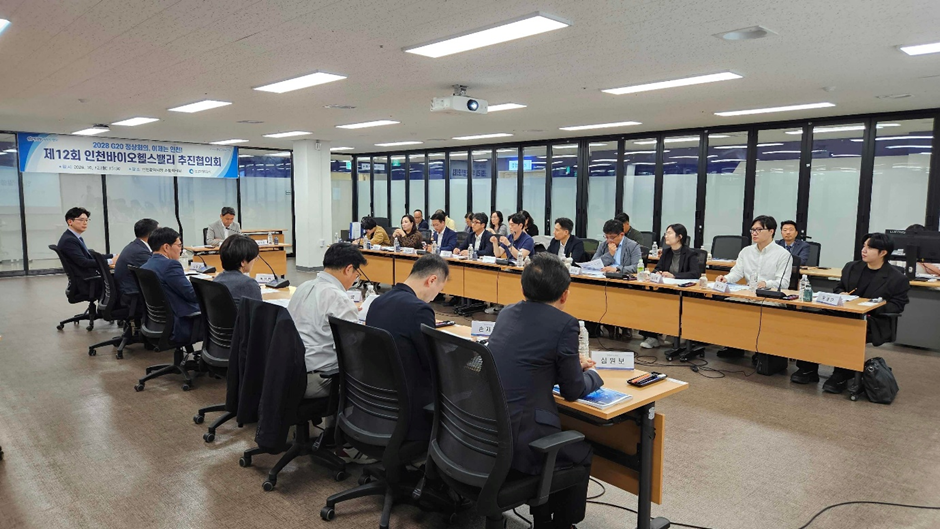
Incheon is accelerating efforts to build a future innovation ecosystem that goes beyond the production-centered bio-industry paradigm to integrate research and development (R&D) with the cultivation of specialized talent.
Incheon Metropolitan City announced on the 12th that it held the “12th Incheon Bio-Health Valley Promotion Council” meeting at City Hall.
The Incheon Bio-Health Valley Promotion Council, a consultative body tasked with reviewing and advising on key policies and comprehensive plans for the fostering and development of Incheon’s bio-health industry, consists of 19 members, including representatives from companies, universities, hospitals, research institutions, associations, the City Council, and relevant city officials.
At this meeting, the council gathered in-depth expert opinions on the mid- to long-term development direction of Incheon’s bio-industry and the major pending issues, and explored future policy directions.
Key agenda items for the meeting included: ▲ an interim report and consultation on the “Research Project for the Formulation of the Incheon City Comprehensive Plan for the Promotion of the Bio and Digital Health Industry (2027–2031)”; ▲ gathering opinions on operational plans for the Incheon Bio Forum; and ▲ discussions on the direction for establishing the Incheon Institute of Bio-Science and Technology.
First, Incheon City shared the interim results of the “Comprehensive Plan for Fostering the Bio and Digital Health Industry” research project currently underway. This research project, running from May to December 2026, focuses on establishing a strategic framework and formulating a mid- to long-term comprehensive plan to enhance the competitiveness of Incheon’s bio and digital health industries.
At the meeting, experts from industry, academia, research institutes, and hospitals conducted a multifaceted analysis of industrial conditions and the policy environment, presenting practical alternatives for the mid- to long-term vision and strategic direction; the city plans to actively incorporate these suggestions into the process of formulating the final plan.
In addition, participants reached a consensus on launching the “Incheon Bio Forum” and operating an advisory committee in the form of an alliance to foster organic communication and networking among industry, academia, and research institutions.
In particular, to transform the Songdo Bio Cluster from a simple manufacturing and production hub into a sophisticated global innovation hub equipped with research and development (R&D) capabilities and professional training programs, the proposal to establish the “Incheon Institute of Bioscience and Technology”—a graduate school with a capacity of approximately 300 students—by 2030 was discussed in depth.
Incheon City plans to carefully review the recommendations gathered from experts at this council meeting and fully incorporate them into future comprehensive plans and key policies for fostering the bio and digital health industries.
The Director of the Future Industries Headquarters stated, “Close cooperation among industry, academia, research institutes, and hospitals is essential for Incheon’s bioindustry to leap forward from a mere production hub to a true innovation ecosystem where research and development, talent development, and cross-industry convergence occur organically.” He added, “Based on the valuable opinions derived from this consultation, we will proceed without delay to formulate effective policies that will further enhance the global competitiveness of Incheon’s bioindustry.”
