The Incheon Metropolitan City and the Incheon Economic Free Zone Authority announced plans to expand the growth foundation for future industries—such as K-content and biotechnology—based on the industrial infrastructure in Songdo, Yeongjong, and Cheongna, and to strengthen their competitiveness in attracting investment.
The Incheon Economic Free Zone Authority plans to focus on revitalizing investment attraction centered on strategic industries, in line with the “ABC+E” strategy—a core industrial policy of the 9th popularly elected administration.
In addition, the agency intends to strengthen its medium- to long-term growth foundation by revising district-specific development plans to reflect changes in the external environment—including the new designation of an Economic Free Zone in the southern part of Ganghwa Island—and by establishing the “Second Incheon Economic Free Zone Development Plan,” which incorporates strategies for advancing the innovation ecosystem and building a global city of the future.
In Cheongna International City, the project to create a multimedia and cultural complex is moving full steam ahead. As the Cheongna hub for the “K-Culture Eum” project promoted by the 9th popularly elected Incheon City administration, it is expected to drive the revitalization of culture and tourism in conjunction with Jemulpo and Munhak.
The SOM City project—a media and culture complex in Cheongra—reached a new milestone on October 19, when the amendment to its development plan was approved as originally proposed at the 149th meeting of the Free Economic Zone Committee. This decision has resolved the long-standing delays in the project and laid a new foundation for the creation of a complex that integrates film production with cultural and tourism functions.
SOM City is a project to develop a site of approximately 188,282 square meters in Cheongna International City, bringing together film production facilities—such as indoor and outdoor studios, open sets, and a media center—along with cultural and tourism facilities that utilize content intellectual property (IP). Under this revised plan, the land-use plan has been reorganized to focus on the content industry, and the target completion date has been adjusted to December 2031.
The Incheon Economic Promotion Agency plans to use this project as a focal point to attract domestic and international content companies and foreign investment, and to develop Cheongna into a global hub for the video industry. It also expects to revitalize culture and tourism through collaboration with Starfield Cheongna, which is currently under development nearby.
Songdo International City is expanding its scope from a hub for biopharmaceutical production to a global biotech hub encompassing research and development, entrepreneurship, and workforce development.
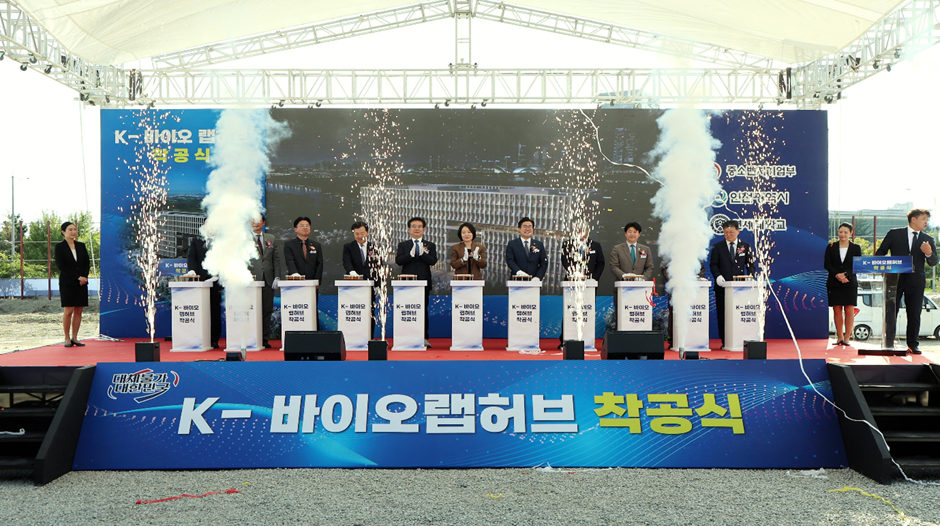
On September 30, a groundbreaking ceremony was held at Yonsei University’s International Campus for the K-Bio Lab Hub (scheduled for completion in 2029), a national biotech startup support facility. Modeled after LabCentral, a biotech startup support organization in Boston, U.S., this initiative supports biotech startups throughout their entire growth cycle—from research and development to commercialization.
Subsequently, on October 20, the practical training center for the World Health Organization (WHO) Global Bio Workforce Development Hub opened its doors. The approximately 2,492-square-meter training facility, located on Yonsei University’s International Campus, is equipped with hands-on training facilities for biopharmaceutical production processes and quality control. Through this facility, the university plans to support the training of specialized personnel in vaccines and biopharmaceuticals for middle- and low-income countries.
According to the Bank of Korea’s Incheon Headquarters, as of 2024, the output value of Incheon’s pharmaceutical and biotech industry stood at 7.7 trillion won, accounting for 61.8% of the national total. The production capacity of the Songdo Bio Cluster also stands at 1.16 million liters, making it the world’s largest for a single city.
The Incheon Economic Promotion Agency’s strategy is to enhance the competitiveness of the biotech industry by adding research and development, startup support, and workforce training capabilities to this existing production infrastructure. In addition, the agency plans to develop a portion of the reserved land in Phase 3 of Yeongjong Sky City into a biotech-specialized complex to boost research and development capabilities.
The Incheon Economic Promotion Agency plans to strengthen the industrial infrastructure in Songdo, Yeongjong, and Cheongna while fostering the southern part of Ganghwa as a new growth hub.
The new designation of the Southern Ganghwa Economic Free Zone is a project targeting an area of 6.32 square kilometers in the Gilsang-myeon and Hwado-myeon districts of Ganghwa County. The plan involves investing approximately 3.1 trillion won by 2035 to establish a hub for future industries, focusing on green and blue biotechnology, physical AI, and integrated tourism.
The Incheon Free Economic Zone Authority has formulated the “Second Incheon Free Economic Zone Development Plan,” which includes this project, and plans to submit it to the Ministry of Trade, Industry and Energy following a final briefing session this December.
At his inauguration ceremony on September 18, the head of the Incheon Free Economic Zone Authority stated, “It is now time for IFEZ to move beyond development-centered investment attraction and take a leap forward by shifting to strategic investment attraction that aligns with national industrial strategies and changes in global supply chains.” He added, “We will create an innovation ecosystem where corporate technology and capital connect with universities, research institutions, and entrepreneurs, leading to the creation of new future industries and jobs.”
The Incheon Free Economic Zone (IFEZ) has grown by attracting global companies and high-tech industries since it was designated as South Korea’s first free economic zone in 2003. As of the end of 2024, there were 3,860 tenant companies, 122,832 employees, and total revenue reached 113.2602 trillion won. Cumulative reported foreign direct investment stood at $17 billion as of the end of 2025.
