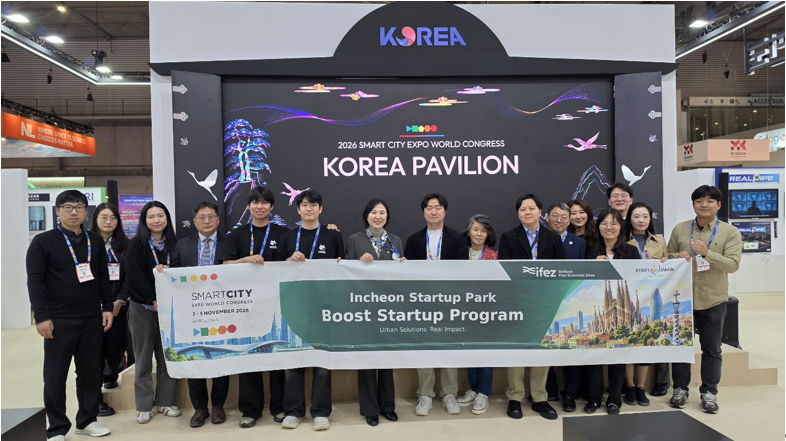
Taking advantage of a world-renowned smart city expo, Incheon City is strengthening policy cooperation with major international organizations and cities while unveiling a future urban development vision aimed at implementing its “Master Plan” and revitalizing the historic downtown area.
Incheon Metropolitan City announced that on the 4th (local time), it attended the “2026 Smart City Expo World Congress (SCEWC)” held in Barcelona, Spain, to discuss urban policy cooperation with international organizations and cities abroad and to examine on-site case studies relevant to the revitalization of its historic downtown area.
The Smart City Expo World Congress (SCEWC) is the world’s largest exhibition where cities, companies, and international organizations from around the globe participate to share smart city policies, cutting-edge technologies, and directions for sustainable urban development.
The Deputy Mayor for Balanced Development met with Jordi Castellana, Vice President of the Barcelona Metropolitan Authority (AMB), to discuss ways to exchange policies between the “Barcelona Metropolitan Urban Master Plan (PDUM)” and the Incheon Urban Master Plan.
The Barcelona Metropolitan Urban Master Plan (PDUM) is a spatial plan for 2050 covering Barcelona and 35 surrounding municipalities; the city plans to use it as a reference for reorganizing its central area system and promoting balanced development across different living zones. Both sides also agreed on the need for policy exchange in the areas of urban data utilization and citizen-centered urban planning.
Subsequently, the Deputy Mayor met with Edlam Abera Yemeru, Director of the United Nations Human Settlements Program (UN-Habitat), to introduce an AI-based urban planning support system and a citizen participation platform, and to discuss from various angles the potential for cooperation in citizen-centered urban planning utilizing AI and urban data.
In addition, the delegation visited the Montjuïc Olympic Stadium and surrounding facilities to examine examples of repurposing large-scale international event venues into spaces for sports, performances, and culture. The city plans to incorporate these approaches to linking existing facilities with public spaces into strategies for utilizing historical and cultural assets in the old downtown area—such as the Jemulpo Freedom Park area and the vicinity of Munhak Mountain—and for revitalizing these neighborhoods.
Furthermore, the Deputy Mayor visited the exhibition spaces of Incheon-based companies and related organizations participating in the Smart City Expo World Congress (SCEWC) to gather on-site feedback regarding technology demonstrations and overseas expansion. He also visited national city pavilions to promote Incheon’s bid to host the “2028 G20 Summit.”
The Deputy Mayor for Balanced Development stated, “We will incorporate Barcelona’s long-term spatial planning and experience in urban space utilization into the ‘Incheon Master Plan and Neighborhood Plans,’” adding, “We will do our utmost to ensure that the transformation of the historic downtown leads to improvements in the living environment that citizens can tangibly feel and to the revitalization of the area.”
Incheon City plans to actively incorporate the results of this overseas exchange and field survey into its urban planning and downtown revitalization policies, and to continue expanding international cooperation with cities abroad.
