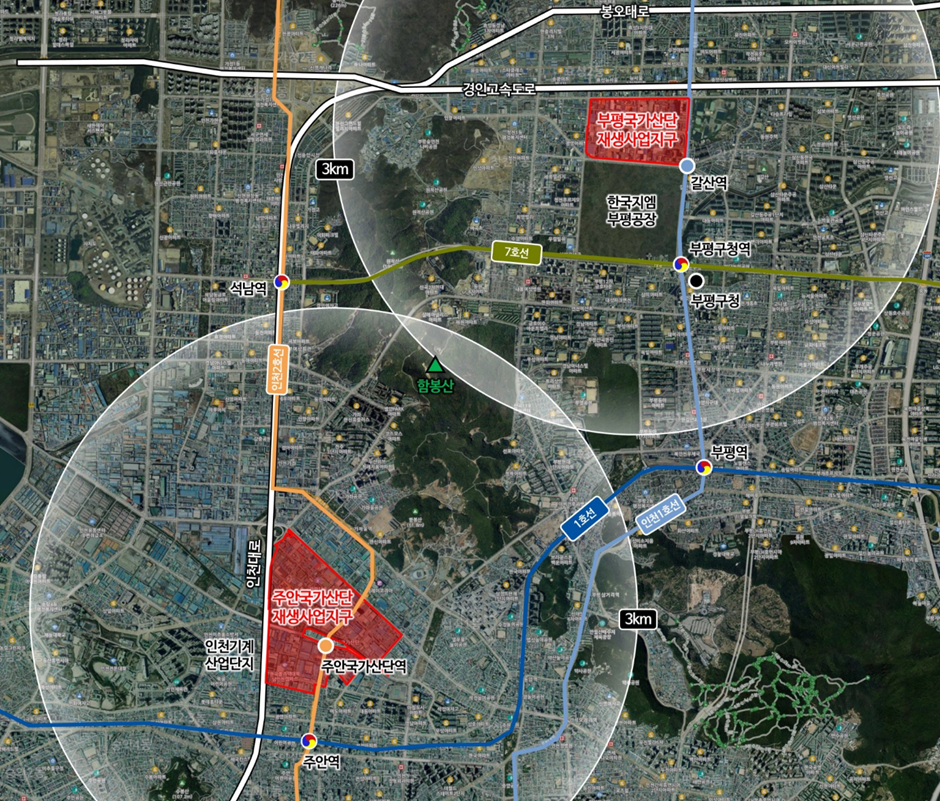
Incheon City is set to strengthen industrial competitiveness by comprehensively upgrading the infrastructure of aging national industrial complexes—which were established over 50 years ago—and improving working and living conditions.
Incheon Metropolitan City announced that the project is now moving full steam ahead, following the final notification on the 6th that the draft regeneration district plan—aimed at strengthening the competitiveness of the Korea Export (Bupyeong·Juan) National Industrial Complex, which has led South Korea’s industrialization—was approved as originally proposed during a review by the Ministry of Land, Infrastructure and Transport’s Industrial Site Policy Deliberation Committee on the 28th of last month.
Since their establishment in the late 1960s, the Bupyeong and Juan National Industrial Complexes have driven the nation’s industrial development; however, issues such as the weakening competitiveness of tenant companies, aging infrastructure, and a shortage of parking spaces have been consistently raised.
Following its selection in May 2020 for the government’s “Industrial Complex Overhaul Competition” and its designation in March 2021 as a “Competitiveness Enhancement Zone for Aging Industrial Complexes,” the city formulated the regeneration project plan over the past five years after conducting surveys on corporate conditions and gathering feedback from workers and management.
This regeneration project will be carried out from the first half of 2027 through December 2029. With a total project budget of 34.1 billion won—including 17 billion won in national funding—infrastructure in three key areas will be upgraded in phases: expansion of parking facilities, landscaping, and improvements to roads and pedestrian environments.
Key initiatives include expanding parking capacity by a total of 493 spaces—comprising 206 spaces in the Incheon Bridge Park underground parking garage and 287 on-street parking spaces—to alleviate the chronic parking shortage within the industrial complex. The Incheon City Comprehensive Construction Headquarters will oversee the parking facility construction from the first half of 2027 through the end of 2029, with the goal of reducing parking inconveniences for workers and visitors and improving the traffic environment.
Work will also proceed to improve green spaces to provide workers with rest areas and a pleasant environment. The green space improvement project, covering a 21,274-square-meter area of Incheon Bridge Green Space, will be carried out by the Seohae District Office starting in the first half of 2027. It aims to enhance the industrial complex’s landscape by connecting the green spaces and pedestrian networks with the adjacent Incheon Bridge Park and Bupyeong Yeolwoomul Forest.
In addition, themed improvements to the pedestrian environment will be implemented in parallel, reflecting the characteristics of each major road within the industrial complex. Gilparo Road in the Juan District will be transformed into a metasequoia forest path, while Yeomjeon-ro will be developed into a youth culture street; Annam-ro and Pyeongcheon-ro in the Bupyeong District will also be upgraded. A vibrant street environment will be created by repaving aging sidewalks, installing smart shade structures and art benches, expanding parking facilities for bicycles and personal mobility devices (PM), installing smart streetlights and nighttime lighting, and creating garden-style green belts.
The Mayor of Incheon stated, “We will carry out the Bupyeong and Juan National Industrial Complex regeneration project without delay to expand insufficient infrastructure and improve working conditions,” adding, “We will breathe new life into these aging industrial complexes by improving living and working conditions and strengthening the competitiveness of tenant companies.”
Incheon City plans to approve and announce the regeneration district plan in November and carry out phased redevelopment projects without delay—from the start of construction in the first half of 2027 through completion in December 2029—to transform the aging industrial complexes into vibrant industrial spaces that attract young people and businesses.
