[COLUMN] A Global Crossroads Hidden in Incheon’s History
A Global Crossroads
Hidden in Incheon’s History
인천 역사 속에 숨은
글로벌 문화 교차점
By Oh Sang-mee
(Assistant Professor, Department of Modern and Classical Languages, George Mason University Korea Ph.D. in Korean History, Department of Asian Languages and Cultures)
글. 오상미(한국조지메이슨대학교 현대고전언어학과 조교수 / 아시아언어문화학과 한국사 전공 박사)
1. Jemulpo Port in 1904 (Source: Incheon Metropolitan City Website) 2. A view of the Incheon Open Port area
1. 1904년 제물포항의 모습(출처 인천광역시청 홈페이지) 2. 인천개항장 거리 전경
On May 17, 1888, a 20-year-old American stood on the deck of a ship, gazing toward the approaching port. He was George Heber Jones, a Methodist missionary bound for Joseon. Before him lay Jemulpo, already a city where cultures converged. Chinese-style brick buildings lined one side of the main street, while Japanese wooden houses stood on the other. On the hillside were the foreign settlements of the United States, Britain, France, and Germany, with a Korean village beyond. One building immediately caught his eye: a three-story Western-style structure overlooking the harbor. It was Daebul Hotel, the first Westernstyle hotel in Joseon, completed earlier that year. With Seoul still a 12-hour walk away, Jones decided to spend the night there. At the time, he could not have known that just four years later he would return to Jemulpo—and spend the next 11 years of his life there.
1888년 5월 17일, 스무 살의 미국인 청년 하나가 갑판 위에 서서 다가오는 항구를 바라보고 있었다. 그는 감리교 선교사로 조선에 파견된 조지 허버 존스(George Heber Jones)였다. 그의 눈앞에 펼쳐진 제물포는 이미 여러 문화가 뒤섞인 도시였다. 큰길을 사이에 두고 왼쪽에는 청국식 벽돌 건물이, 오른쪽에는 일본식 목조 가옥이 늘어서 있었고, 그 위 언덕으로는 미국, 영국, 프랑스, 독일인 등이 모여 사는 각국 조계지가, 그 너머로는 조선인 마을이 자리하고 있었다. 언덕 위 3층짜리 서양식 건물이 눈에 들어왔다. 그해 막 완공된 조선 최초의 서양식 호텔, 대불호텔이었다. 목적지인 서울까지는 걸어서 열두 시간, 존스는 하루 묵기로 하고 호텔로 발걸음을 옮겼다. 이때만 해도 그는 알지 못했다. 4년 뒤 자신이 이곳으로 다시 돌아와 이후 11년을 이곳에서 살게 되리라는 것을.
3.Incheon—present-day Jemulpogu—around the time the port opened (Source: Incheon Metropolitan City Website)
3. 개항당시 인천(현 제물포구)의 풍경(출처 인천광역시청 홈페이지)
4. The Incheon Open Port area, where historic buildings are preserved
4. 옛 건축물들이 보존되어 있는 인천개항장 거리
Gateway to Global Culture: Incheon
세계 문화의 관문, 인천
Just five years earlier, Jemulpo had been little more than a small fishing village with several thousand residents. That changed after the Treaty of Ganghwa was signed in 1876. As Joseon opened its ports and entered modern treaties with foreign nations, this modest harbor became the principal gateway for foreigners entering the country.
불과 5년 전만 해도 제물포는 수천 명이 사는 작은 어촌에 지나지 않았다. 그러나 1876년 강화도 조약 이후 조선이 문호를 개방하고 세계 각국과 근대적 조약을 맺기 시작하면서 이 작은 포구는 외국인들이 조선에 들어오기 위해 반드시 거쳐야 하는 관문이 되었다.
Why Incheon? The answer lay in its strategic location. At a time when ships connected the world, Incheon stood at the mouth of the Han River, the waterway leading toward Seoul. Western vessels naturally converged here. The French fleet anchored near Ganghwado in 1866, followed by the U.S. fleet in 1871, both seeking trade and displaying military power.
왜 하필 인천이었을까? 그것은 인천의 지정학적 위치 때문이다. 세계를 잇는 수단이 배였던 시절, 인천은 서울로 이어지는 한강 하구에 자리 잡고 있었기 때문에 서양의 배들은 번번이 인천 일대로 몰려들었다. 1866년 프랑스 함대가, 1871년 미국 함대가 통상과 무력시위를 위해 정박했던 것도 강화도 인근이었다.
The 1876 treaty, concluded after a show of force by the Japanese gunboat Unyo, was far from an agreement between equals. It was an unequal treaty that granted extraterritorial rights. Even so, it marked Joseon’s entry into the modern capitalist world. As the port closest to the capital, Jemulpo became the gateway linking Joseon with the wider world. Japanese merchants, Western diplomats and missionaries, and Chinese laborers all entered through its harbor.
Jemulpo naturally became a place of many firsts. Korea’s first Westernstyle hotel opened here, and in 1899 the country’s first railway began operating between Incheon and Seoul.
1876년, 일본 군함 운요호의 무력시위 끝에 강화도에서 맺어진 조약은 대등한 만남의 결과는 아니었다. 치외법권 조항이 담긴 불평등 조약이었다. 그럼에도 이 조약을 기점으로 조선은 근대 자본주의 세계로 편입되게 되었다. 수도에서 가장 가까운 항구인 제물포는 그렇게 세계와 조선을 잇는 관문이 되었다. 일본인 상인들도, 서양의 외교관과 선교사도, 중국인 노동자들도, 모두 제물포를 통해 조선에 들어왔다. 자연스럽게 제물포는 ‘최초’의 것들이 생겨나는 장소가 되었다. 한국 최초의 서양식 호텔이 생겨난 곳이 이곳인 것도, 1899년 한국 최초의 철도가 이곳에 놓여 서울과 인천을 잇게 된 것도 이상한 일이 아니다.
1. Jjajangmyeon Museum in Incheon Chinatown
1. 인천차이나타운 내 자리한 짜장면박물관
2. Inside the museum, where visitors can explore the history of jjajangmyeon
2. 짜장면의 역사를 엿볼 수 있는 박물관 내부
The Concessions: Where Cultures Blended and New Traditions Emerged
조계지, 뒤섞임이 새로운 문화가 되는 공간
Jemulpo was more than simply the place where Western culture first entered Korea. It was also where different cultures met and created something new. Governed by the laws of their respective countries, the foreign concessions were effectively separate territories within Joseon. Even in this unequal setting, however, people encountered one another every day, and those encounters gave rise to unexpected cultural exchanges. As demand grew for Western-style infrastructure, including railways, large numbers of Chinese laborers from Shandong Province arrived in Incheon to work on construction sites. Chinese restaurants soon opened around the Qing concession to feed them. A popular dish was zhajiangmian—noodles served with a quickly stir-fried bean sauce.
제물포는 단순히 서양의 것들을 ‘최초’로 들여온 곳이었던 것만이 아니라, 여러 문화가 한데 섞이면서 새로운 문화들이 생겨난 곳이기도 했다. 조계지는 각국이 자국의 법으로 다스리는, 조선 땅 안의 또 다른 나라였다. 이 불균형한 공간에서도 사람들은 매일 마주쳤고, 그 마주침 속에서 뜻하지 않은 것들이 태어났다.
철도를 비롯한 서양식 건설 기술이 필요해지자, 산둥반도 출신 중국인 노동자들이 대거 인천으로 들어와 건축 현장을 맡았다. 자연히 이들의 식사를 책임지기 위한 중국 음식점들도 청국 조계지를 중심으로 생겨났다. 가장 인기가 있었던 것은, 노동자들을 위해 빠르게 볶아내는 비빔면, 즉 ‘작장면’이었다
Over time, the dish evolved in an unexpected direction. Koreans developed a taste for the unfamiliar noodles, and the original light-brown sauce gradually became the rich black sauce made with plenty of onions that is familiar today. The result was jjajangmyeon: neither purely Chinese nor purely Korean, but a cultural fusion born in the alleys where different cultures met. Today, the Jjajangmyeon Museum in Incheon Chinatown preserves the story of this culinary heritage.
그런데 시간이 흐르면서 이 음식은 뜻밖의 방향으로 바뀌어 갔다. 한국인들이 이 낯선 국수에 맛을 들이기 시작한 것이다. 황갈색이던 소스는 양파를 잔뜩 넣은 검고 진한 소스로 변했고, 새로운 ‘짜장면’이 탄생했다. 단순히 중국 음식도 한국 음식도 아닌 자장면은, 서로 다른 문화가 국경 없이 맞부딪히던 조계지의 골목에서 태어난 문화적 혼종이다. 지금도 인천 중구 차이나타운에는 짜장면 박물관이 남아 이 뒤섞임의 역사를 증언하고 있다.
3. Naeri Church, Korea’s first Methodist church (Source: Incheon Metropolitan City Website)
3. 한국 최초의 예배당인 내리교회(출처 인천광역시청 홈페이지)
4. Naeri Church today
4. 내리교회 현재 모습
Incheon as a Gateway to the World: Naeri Church and Hawaii
나가는 문으로서의 인천: 내리교회와 하와이
On December 22, 1902, Jones stood once again at Jemulpo Port. Having returned to Jemulpo 10 years earlier to serve as pastor of Naeri Church, he now knew the port well. Yet he was there that day for a reason beyond the church itself.
1902년 12월 22일, 존스는 다시 제물포항에 와 있었다. 10년 전 다시 제물포로 돌아와 내리교회의 담임을 맡았던 그에게, 제물포항은 이제 익숙한 곳이었다. 그러나 존스가 그날 거기에 있었던 이유는 교회 문제 때문은 아니었다.
Jemulpo served as a gateway in both directions. Just as foreigners entered Joseon through its port, Koreans departed from Incheon for the wider world. That day, 121 Koreans gathered at Jemulpo to embark on the country’s first officially organized migration to Hawaii. Following the severe drought of 1901, King Gojong approved Korean emigration to Hawaii, and Horace Allen, the U.S. minister to Korea, arranged the program at the request of the Hawaiian Sugar Planters’ Association. Jones encouraged members of Naeri Church to take part, explaining that they would receive higher wages, housing, medical care, and educational opportunities for their children. Nearly half of the emigrants were members of his congregation. Before the ship departed, Jones led a worship service for the 121 travelers at Jemulpo Port. Between that first migration in 1902 and 1905, about 7,000 Koreans left Incheon for the wider world on 64 voyages.
제물포의 관문 역할은 한 방향으로만 작동한 게 아니었다. 외국인들이 제물포를 통해 조선에 들어왔듯, 조선인들도 인천을 통해 세계로 나갔다. 그날 제물포에는 하와이로 첫 공식 해외 이민을 떠나는 한국인 121명이 모여 있었다. 1901년의 가뭄으로 고종이 한국인들의 하와이 이민을 승인하고, 당시 주한 미국 공사 호레이스 알렌이 사탕수수 농장주 연합의 요청을 받아들이면서 한국인들의 하와이 이민을 주선했다. 한국인들에게 이민을 가는 게 어떠냐고 설득한 것은 존스였다. 그는 미국에서는 급료도 높고, 집과 의료비가 제공되고, 자녀를 위한 교육도 시킬 수 있다며 내리교회 교인들을 설득했다. 이민단 중 절반가량은 내리교회의 교인들이었다. 존스는 그날 한국을 떠난 121명을 위해 제물포항에서 예배를 인도했다. 1902년의 첫 이민 이후 1905년까지 64차례에 걸쳐 7천여 명이 인천을 떠나 세계로 나갔다.
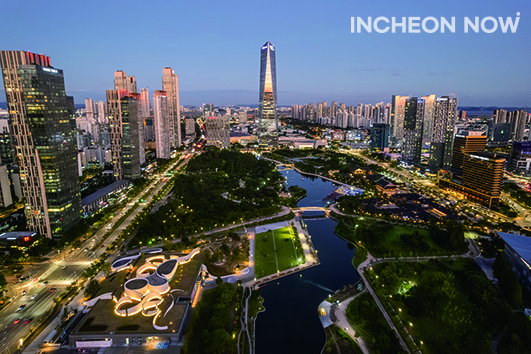
A panoramic view of Songdo International City / 송도국제도시 전경
Once Again, a Gateway and Global Cultural Crossroads
다시, 관문이자 글로벌 문화의 교차점으로
As air travel reshaped global connections and Incheon International Airport opened in 2001, Incheon again became a gateway—a place where international visitors first arrive in Korea and Koreans depart for the wider world.
Centered around the airport, the Incheon Free Economic Zone (IFEZ) was established across Songdo, Cheongna, and Yeongjong, attracting international education institutions, research institutes, and global organizations. Songdo, where I live, is home to the Green Climate Fund and global companies including Samsung Biologics. Incheon Global Campus, where I teach, brings together overseas universities such as George Mason University Korea and SUNY Korea, with Korean and international students studying and living side by side.
In this sense, Incheon’s emergence as a K-culture hub is not a new story. Ever since the young George Heber Jones first arrived in Jemulpo in 1888, the city has been a place where cultures meet and make something new. Just as jjajangmyeon was born in the concessions, new forms of exchange continue to appear on Songdo’s campuses, where Korean and international students gather at Chuseok to share holiday dishes in an American-style campus celebration.
비행기가 세계를 연결하기 시작하고 2001년 인천국제공항이 문을 열면서 인천은 다시 세계인들이 한국을 찾아 첫발을 딛고, 한국을 떠나 세계로 나가는 사람들이 거쳐 가는, 글로벌한 문화의 교차점이 되었다.
인천국제공항을 중심으로 송도, 청라, 영종 세 지구에 인천경제자유구역이 생겨났고, 외국 교육기관, 연구기관, 국제기구들이 자리 잡았다. 필자가 살고 있는 송도에는 녹색기후기금과 같은 국제기구와 삼성 바이오로직스같은 글로벌 기업이, 필자가 근무하는 인천 글로벌 캠퍼스에는 조지메이슨대, 뉴욕 주립대 같은 해외 대학들이 자리 잡고 있다. 한국 학생들과 국제학생들이 어우러져 살아가는, 한국에 있는 미국 대학이다.
What has changed is the nature of those encounters. The foreign concessions and Korean villages of the late 19th century existed in an unequal relationship. Today, Songdo’s classrooms are places where cultures meet on equal footing. As they continue to intersect and blend, they are shaping Incheon into a global cultural city. And just as a young Jones once stepped ashore at an unfamiliar port, countless people continue to arrive in Incheon and begin journeys of their own.
결국 인천이 K-컬쳐 허브로 주목받는 지금의 현상은 새로운 이야기가 아니다. 1888년, 스무 살의 존스가 제물포에 첫발을 내디뎠던 순간부터, 인천은 여러 문화가 뒤섞이며 무언가를 빚어내는 도시였다. 조계지에서 짜장면이 탄생했듯, 지금 송도의 캠퍼스에서도 추석이면 한국학생과 국제학생이 명절 음식을 나눠 먹는 미국식 파티가 열리는 등, 또 다른 혼종의 문화들이 태어난다. 다만, 그 관계는 달라졌다. 치외법권으로 보호받던 외국인의 구역과 그 바깥의 조선인 마을은 대등하지 않았지만, 지금 송도의 강의실에는 그런 위계가 없다. 이제 문화들은 대등한 위치에서 서로 교차하고 뒤섞이며 인천을 글로벌 문화 도시로 만들어 가고 있다. 갑판 위에서 낯선 항구를 바라보던 스무 살 청년이 그랬듯, 지금도 수많은 이들이 이 도시에 첫발을 딛고 있다.
